
Springtime Umbria: discover with us the most beautiful villages, where nature and history coexist in perfect harmony
This has been celebrated as the year of the Borghi in Italy, with an explicit call for tourism interested in truer, less touristy realities, without being less beautiful.
In this sense, Umbria can take special pride in its ability over time to maintain intact and beautiful medieval villages, perched hamlets and minor towns with works of art whose interest transcends regional boundaries to be the result of Italy’s best artistic expression.
The list would be too long if we wanted to go through the set of the many realities that dot Umbria and are certainly worth visiting. I will therefore be forced to make a choice, starting with some interesting ideas for guided tours to take together.
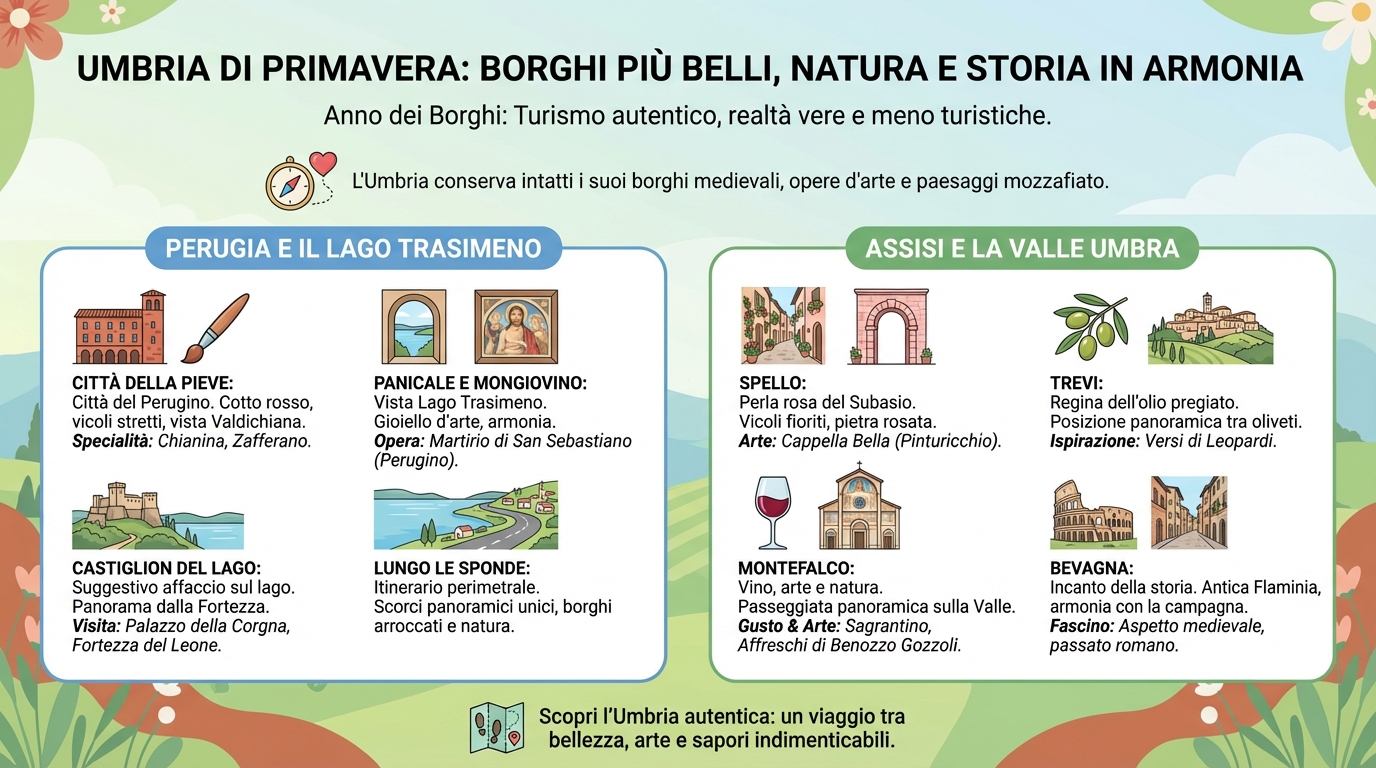
For convenience, I have linked lesser-known villages and towns with major cities or well-known landscape settings:
Perugia and Lake Trasimeno
1. Città della Pieve, the town of Perugino.
In addition to Perugino’s famous frescoes, there is the town, all built in the orange-red color of terracotta, with its narrow alleys and exceptional views of the Valdichiana, to visit. Don’t forget a stop to taste the famous Chianina beef, in the form of tagliata or in the ragout of Pici, and saffron.
2. Panicale and the Sanctuary of Mongiovino.
With an unforgettable view of Lake Trasimeno, this small village is a jewel of art, grace and harmony: the fresco of the Martyrdom of St. Sebastian is one of Perugino’s finest works and is only the tip of a beauty that winds its way through concentric alleys, churches and ancient buildings.
3. Castiglion del Lago.
This beautiful village is also one of the most picturesque viewpoints towards Lake Trasimeno, particularly if you decide to visit the Palazzo della Corgna and the Lion Fortress, from whose terraces the view sweeps freely for a panorama that includes the towns and villages along the shores and the entire Trasimeno lake.
4. Along the shores of Lake Trasimeno, amid panoramic views and small perched villages.
This route favors the itinerary that follows the perimeter of the lake, opening up to the view a panorama that is never the same, in a succession of truly unforgettable perspectives and views, both on a naturalistic level and for the small and charming villages that punctuate and accompany the route.
Assisi and the Umbrian Valley
1. Spello: flower-lined alleys and art of the pink pearl of Subasio.
Considered a real pearl of Subasio, this town with the pinkish color of the local stone is at the same time a privileged place for the beauty of its nature, the characteristic style of the medieval town with its alleys and, of course, the custodian of one of the most important works of Italian art: the Cappella Bella frescoed by Pinturicchio for the Baglioni family.
2. Trevi, queen of fine olive oil.
A symbolic city of fine Umbrian olive oil, Trevi has such a beautiful panoramic position that it is at one with the natural surroundings of the valley and mountains covered by the silvery green of the extensive olive groves.
The aerial view of its rooftops in this dreamlike landscape did not escape the poetic gaze of Leopardi, who dedicated verses to it.
3. Montefalco, the pleasure of living among wine, art and nature.
Wine, art at the highest level, vineyards and nature for the city of Frederick II of Swabia’s Falcon. After or before a glass of Sagrantino, enjoy a scenic walk overlooking the entire Umbrian Valley, from Spoleto to Perugia, and a visit to Benozzo Gozzoli’s frescoes in San Francesco.
4. Bevagna, the enchantment of history on the ancient route of the Flaminia.
The natural beauty and harmony of this small village lies in its relationship with its countryside, among rows of vines and hills, in its medieval appearance and its Roman past, in the grace of its alleyways as in the surprise of its square, enclosed among some of the most important monuments of Romanesque Umbria. Not least, the