
Città di Castello, home of the brilliant Alberto Burri, can boast the title of a true Capital of Contemporary Art. The centenary of this volcanic and unpredictable great “master” in 2015 saw New York and the Guggenheim Museum take sides among the great supporters of his innovative artistic vision.
Alberto Burri, in fact, can be considered among the most fascinating artists on the international scene in the postwar period. His works can be found in the world’s most important museums, from the Tate Gallery in London to the Guggenheim Museum in New York.
However, Burri is, at least as far asItaly is concerned, yet to be discovered or, at best, rediscovered.
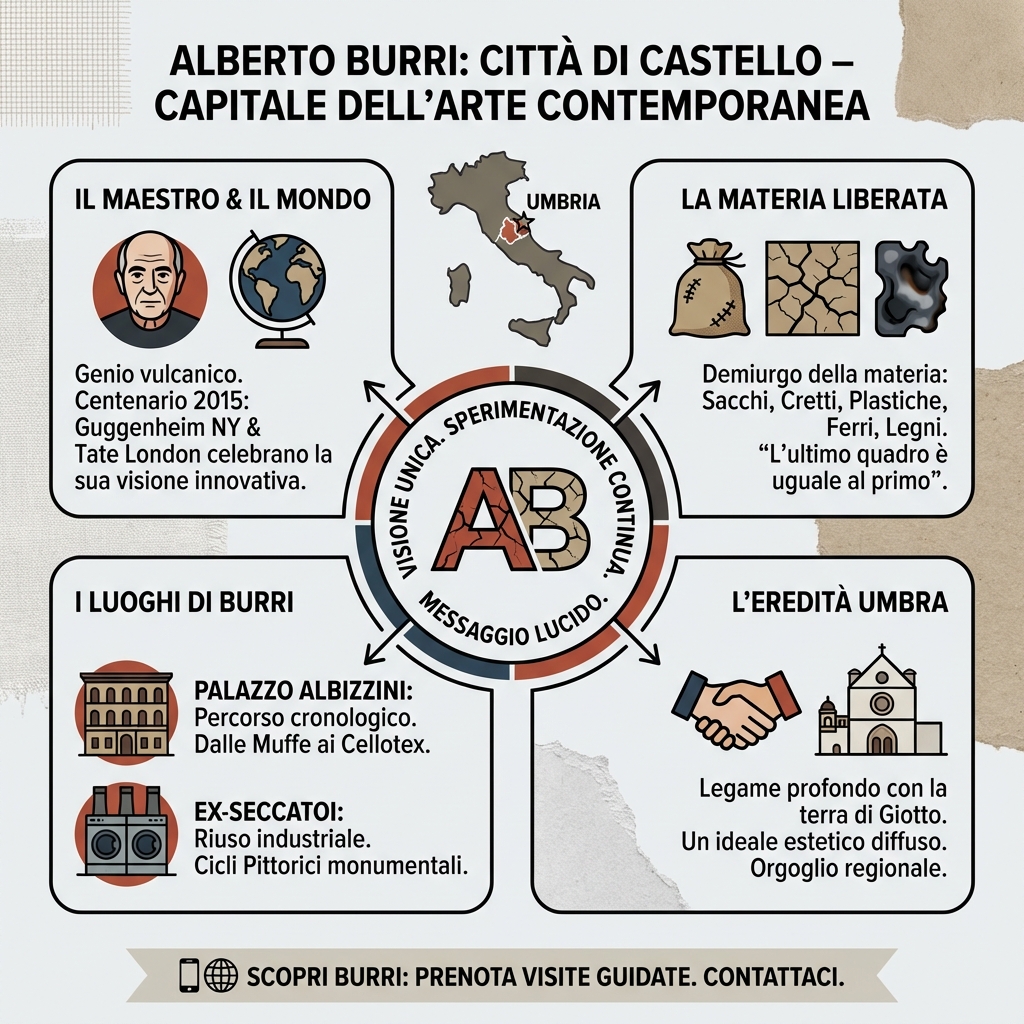
The complexity of his vision and, together, the firm lucidity of his message are elements that have always attracted me to his works. From the famous “Sacks,” which caused outcry and made him famous, to the monumental “Cretti” and the Pictorial Cycles of the Ex-Seccatoi di Tabacco, a unique thread runs through his production.
He himself, referring to his work, had said, “The last of my paintings is the same as the first,” knowing that no one in the face of that anxiety of experimentation and research could ever accuse him of repeating himself.
Many of his admirers will, to be sure, have found it somewhat singular that he chose to make his hometown, Città di Castello, so isolated and distant from the most innovative artistic currents, the place of choice to bring his vision to life, in its entirety and in all its variations.
In this corner ofUmbria, Burri, however, firmly wanted to bring together and curate the display of his production. The work, on the other hand, belongs to the place where it lives, transforming the container-contained pair into a single appearance.
Burri felt as a compelling necessity the link with his native land. Thus, the collection set up by Burri himself in the fifteenth-century Palazzo Albizzini, in the heart of Città di Castello, accompanies us with chronological succession through the different experiments.
Burri, demiurge of matter in its various appearances, aimed to redeem its humility and liberate it: the Molds, the Sacks, the Hunchbacks, the Irons, the Woods, the burned plastic, up to the Cretti and Cellotex.
The Ex-Seccatoi – a prescient example of the reuse of an “industrial” structure – is itself a great work of art that contains those pictorial cycles that testify to the deep connection between Burri and that Umbria that had hosted Giotto, Cimabue and the Sienese masters in the great building site of the Basilica of St. Francis in Assisi.
It is with a certain pride that I see in this land, Umbria, the imprint of those artists who elected it as a place of beauty and an aesthetic ideal legible in its cities, its landscape and its museums.
If you would like to arrange guided tours of Città di Castello to discover Burri, you can contact us through the website or call us directly.